Photo: Spade Himalaya — Lukla Airport’s famously short, sloping runway in Nepal’s Khumbu region.
If you’re planning a trek to Everest Base Camp, Gokyo or the Three Passes, there’s one part of the journey that can throw even the best-laid itinerary into chaos: Lukla.
I know that from experience. My own Everest Base Camp and Gokyo Lakes trek involved helicopters, unexpected landings and more than a little uncertainty around getting in and out of the mountains.
But why do flights to Lukla actually get cancelled when the weather can sometimes look perfectly fine?
I asked Pawan Bhattarai, Co-Founder of Spade Himalaya, to explain what really happens behind the scenes. Drawing on information from his team of licensed Nepali guides, Lukla airport and official aviation sources, Pawan explains why flights stop, how the Manthali system works, what happens when you get stranded — and the one thing you can do when planning your trek that can make all the difference.
You are standing outside a lodge in Lukla at half past six in the morning, bag packed, and nothing is moving. The sky above you looks perfectly reasonable. Somebody official has said the word “delayed” and walked off, and nobody will tell you anything more useful than that.
And this is the part of an Everest trek that people are least prepared for. It is worth understanding before you book rather than while you are standing there.
I co-founded a trekking and tour company in Kathmandu. Our licensed Nepali guides deal with this every season, and what follows is how the decision actually gets made.
The airstrip is the whole story
First, Lukla’s runway is 527 metres long. For comparison, most commercial runways are measured in thousands of metres.
Also, it slopes at 11.7 per cent, which is steep enough to be visible in photographs. So aircraft land uphill, on runway 06, because the gradient helps them stop. They take off downhill, on runway 24, because the gradient helps them go. And there is a mountainside at the top end and a drop at the bottom. Neither is negotiable.
The airport sits at about 2,845 metres, and it has no instrument approach.
That last detail is the one that matters, and it is the reason this article exists.
No instrument approach means exactly what it says
By contrast, at a normal airport an aircraft can descend through cloud on instruments. The pilot follows a defined path, guided by ground equipment. They only need to see the runway in the final moments. That is why flights land in weather that looks impossible from the terminal window.
But Lukla has none of that. Flights operate under visual flight rules. That means the pilot must be able to see the airstrip in order to fly to it. Not glimpse it. See it, and keep seeing it.
The airport office in Lukla confirmed one detail that is worth spelling out, because it is usually reported as a single condition. Two things have to be right, not one. There has to be enough horizontal visibility, and the cloud base has to be high enough. Either one alone is not sufficient. So a morning that looks bright from the lodge can still be unflyable, because the cloud is sitting lower than the approach needs, and that is not something you can judge by looking up.
So the question is never whether the aircraft is capable of the landing. It is whether the pilot can see where they are going. That is a binary, and no amount of experience, money or urgency changes it.
Two weather windows, one flight
Here is the thing most trekkers do not realise, and it explains a lot of apparently absurd delays.
In short, the weather has to be acceptable at both ends at the same time.
For example, you can stand in Lukla under clear sky. Meanwhile the aircraft that was supposed to collect you cannot depart Kathmandu. You can also be sitting in Kathmandu in bright sunshine while Lukla is closed in. Both feel like nonsense from where you are standing, and neither is.
And worse, the two ends are on different weather systems. Kathmandu sits in a valley at around 1,400 metres. Lukla is in the mountains at twice that. So there is no reason for them to agree, and frequently they do not.
Then add the flight itself. It crosses terrain in between that also has to be passable, and you have three conditions that must line up simultaneously for a fifteen minute flight. Which months give you the best odds of all three lining up is a separate question, and one we have set out in our Everest Base Camp weather guide.
Why everything happens at dawn
So flights to Lukla are scheduled early, and the early ones have far better odds than the later ones.
The published timetable shows exactly that. In the schedule the Civil Aviation Authority of Nepal has current as I write, Summit Air is the scheduled operator on the route, flying Kathmandu to Lukla and back five times a day, seven days a week, on nineteen seat LET-410 aircraft. The first departure leaves Kathmandu at 06:00 and the last aircraft back lands at 16:15. A fifth daily rotation is added partway through September, which is the season being geared up for autumn.
In practice, cloud tends to build through the morning as the day warms. By late morning, the window has often closed. This is why our guides push clients onto the first departure of the day even when it means an unpleasant start, and it is the cheapest risk management available on the entire trip because it costs nothing.
There is also less capacity than people assume. Ten scheduled movements a day is not many for a place that most of the Everest region walks in and out through, and the airport office in Lukla put an average peak season day at around sixteen runs, which will include charter and non-scheduled traffic on top of the timetable. I am giving you both numbers rather than blending them into one, because they are counting different things and I do not know the exact relationship between them.
Either way, that is the whole day’s supply, shared between every airline and every passenger trying to get in or out.
Also, the queue matters. So if the first flights do not go and the weather clears at eleven, the airline is not starting from your booking. It is working through a backlog of people who were already delayed, some of them from previous days.
That is why a single bad morning can push you back further than a single day.
The Manthali complication

Photo: Spade Himalaya - Ramechhap Airport at Manthali – the starting point for many flights to Lukla during peak trekking season.
During the busiest trekking months, a lot of Lukla traffic is moved out of Kathmandu to Manthali Airport in Ramechhap.
On paper, this solves a congestion problem. Manthali is much closer to Lukla by air, so aircraft can make more rotations in the morning weather window.
For the trekker, it creates a different problem. Manthali is roughly four to five hours from Kathmandu by road, depending on traffic and road conditions. To catch a first flight you are therefore leaving Kathmandu at around two in the morning, sometimes earlier.
It is not a pleasant start to a trek. But if your alternative is sitting in Kathmandu while the Lukla weather window closes, it can still be the better option.
The arrangements can change from season to season, so check the latest domestic flight schedule for your specific dates rather than relying on what happened in previous years.
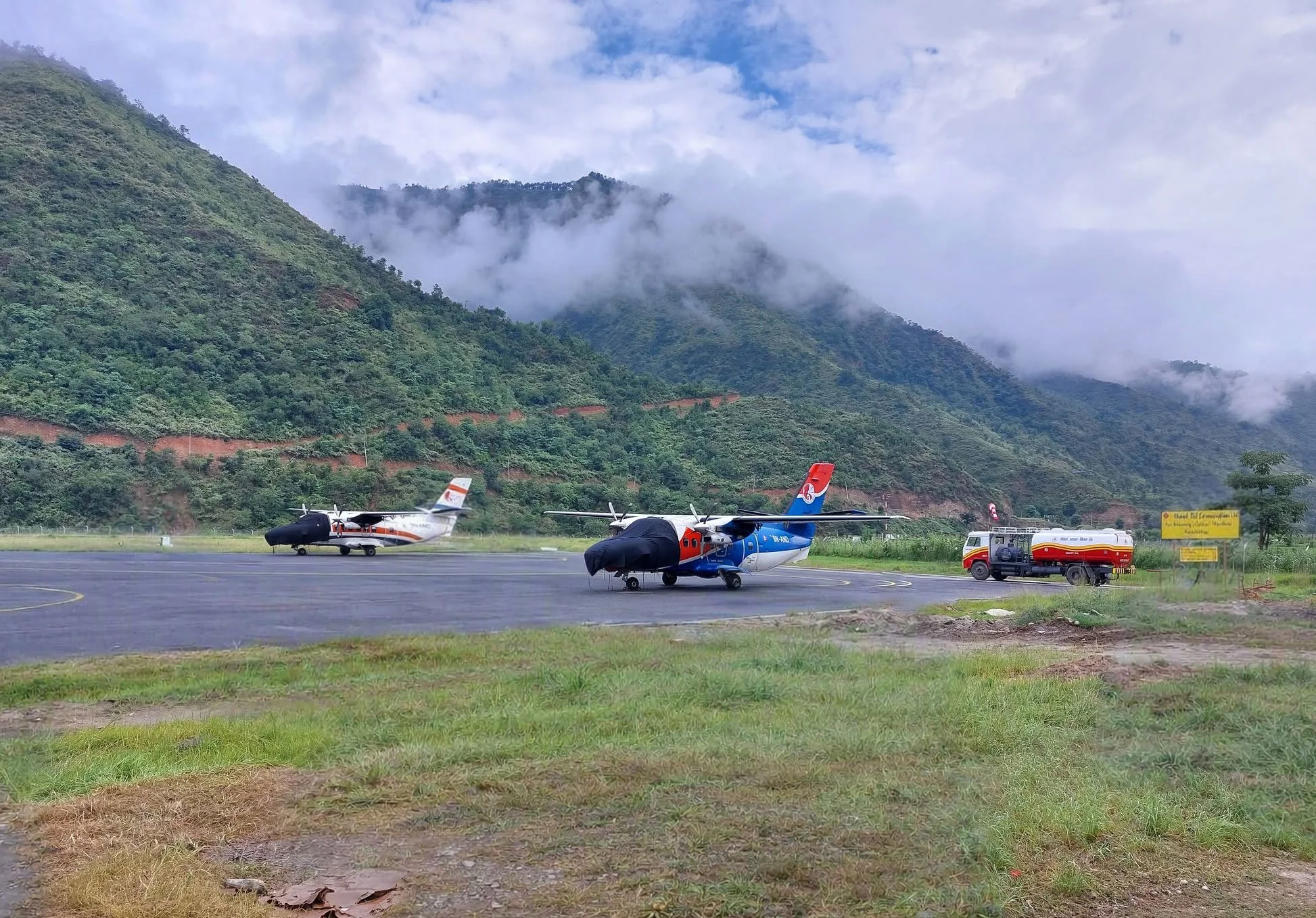
Photo: Spade Himalaya - Aircraft waiting at Ramechhap Airport for the short flight into the Khumbu.
My own experience of Lukla proved just how unpredictable getting in — and getting back out — can be.
When I travelled to Nepal for my Everest Base Camp and Gokyo Lakes trek, our journey into the mountains didn't go remotely according to plan. With fixed-wing flights to Lukla disrupted, we eventually left Kathmandu by helicopter — but even that didn't get us to Lukla.
After a rather eventful journey involving unexpected helicopter landings, we eventually reached Surke, below Lukla, leaving us with an unplanned hike in the dark to reach Chaurikharka.
And the journey home wasn't much more straightforward. After completing the trek and returning to Lukla, bad weather again disrupted flights. Rather than wait indefinitely, we eventually left Lukla on foot, trekking down to Surke in the hope of getting out by helicopter. What followed was another long wait and yet another reminder that, in the Khumbu, your carefully planned itinerary can change very quickly.
It was a fairly dramatic introduction to the realities of travelling in the Himalayas — and a very good lesson in why flexibility matters when Lukla is involved.
Marc Jerrard, Walking in Circles
Pawan continues:
What happens when it stops
The airline does not cancel the first time a cloud appears. Flights go on hold. The aircraft waits at whichever end it is at. The weather is watched.
Sometimes the window opens twenty minutes later and everything moves. Sometimes it does not open that day.
If you are in Lukla and the flight is cancelled, you stay another night. If you are in Kathmandu, you stay in Kathmandu. The airline will rebook you, but you are now competing for seats with the next day’s passengers as well as everyone else who was cancelled with you.
This is where the backlog becomes the problem rather than the weather itself.
It’s also why trekkers shouldn’t assume that getting back to Lukla means the journey is effectively over. Until you’re actually on a flight out of the mountains, the weather can still have the final say.
Helicopters are the fallback, but they are not a guaranteed escape. They need better visibility than people assume, they are expensive, and when fixed-wing flights have been cancelled for a day or two, everybody wants one at the same time. A shared helicopter seat can cost several hundred US dollars. A private charter costs considerably more.
Check your travel insurance carefully before you leave home to understand what cover you have for flight disruption, additional accommodation and alternative transport, including helicopters. Policies vary considerably, so don’t assume you’ll be covered.
The thing that actually determines how this goes
Your itinerary.
Specifically, whether you have a buffer day in Kathmandu before your international flight home.
We put one in every itinerary we run. It is not a rest day and it is not padding. It is there because Lukla closes, and because when it does, the consequences of missing a domestic flight are a great deal smaller than the consequences of missing an international one.
If you fly out of Lukla on schedule, you get a free day in Kathmandu. That is a good outcome.
If you do not, you have somewhere for the delay to go.
I would not book an Everest trek with an operator that does not include one, and I would not remove it from an itinerary to save a day.
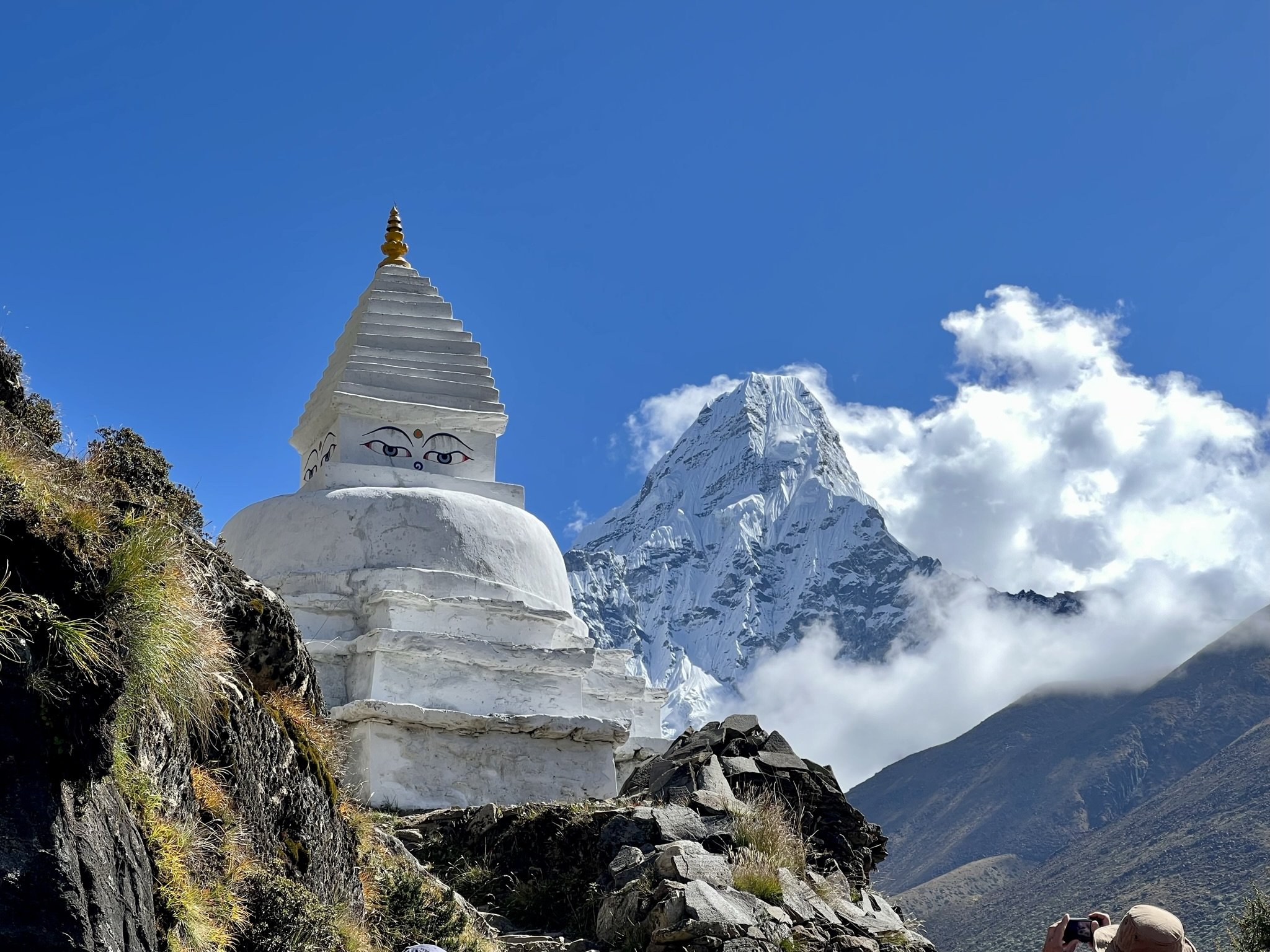
Photo: Marc Jerrard — Ama Dablam rising behind a Buddhist stupa on the trail through the Khumbu.
The honest summary
Lukla is not dangerous because the pilots are reckless. It is demanding because the margin for error is small, and the operating rules reflect that.
When the weather is right, the flight is routine and spectacular.
When it is not, you wait.
That is not a failure of the system. It is the system working properly.
Book the first flight of the day. Expect the possibility of a delay. Keep a buffer day before your international departure. Check exactly what your travel insurance covers if things don’t go to plan.
And if you are standing outside a lodge at half past six in the morning wondering why nothing is moving when the sky looks fine, at least now you know what they are waiting for.